
Explosions in Tehran Test Iran’s Internal Security as Investigators Probe Possible Foreign Link
Breaking: Coordinated Car Bombs Rock Central Tehran
Two car bombs detonated almost simultaneously on Imam Khomeini Street in the Iranian capital Tehran, marking a rare and highly coordinated security breach in the heart of the country.
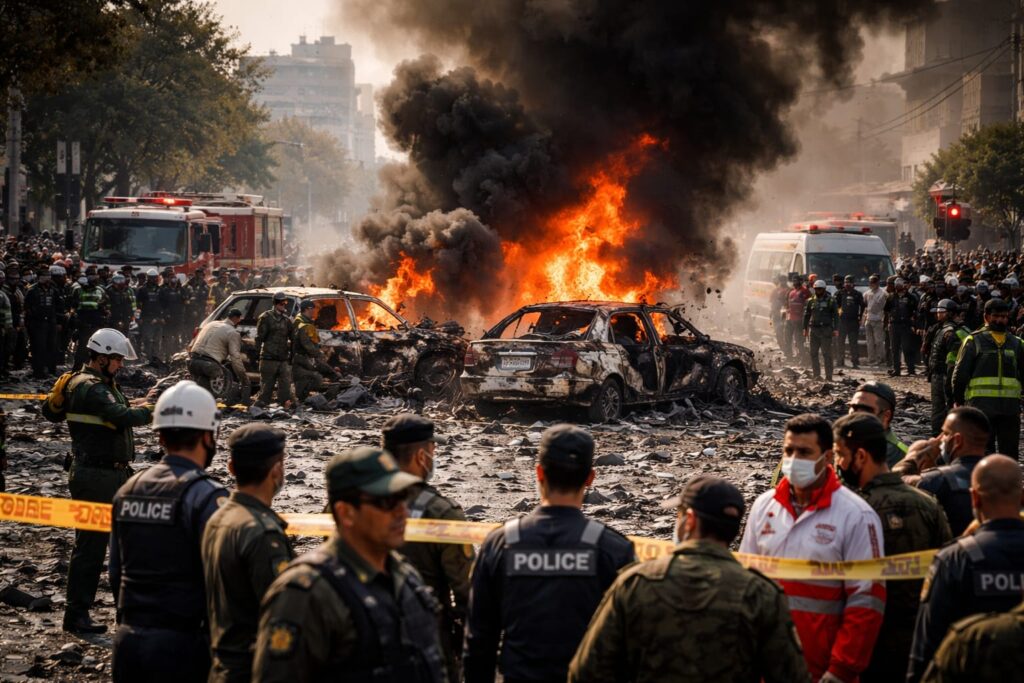
Iranian media confirmed:Iran Observer , Mario Nawfal
BREAKING: Two car bombs exploded on Imam Khomeini Street in Tehran
A third car bomb has been defused
– The area has been completely locked down
– Initial investigations suggest an operation linked to Mossad pic.twitter.com/Zt9lGbBqkT
— Iran Observer (@IranObserver0) April 14, 2026
Two explosions occurred near a checkpoint in western Tehran
A third explosive device was successfully defused
The area has been fully locked down by security forces, including the Basij
Notably, no casualties have been reported, but the implications of the attack go far beyond physical damage.
🚨🇮🇷 BREAKING: Two car bombs detonated near a Basij checkpoint on Imam Khomeini street in Tehran.
Zero casualties.
Sources describe the devices as “extremely amateurish” with limited damage.
Source: @Spectator_MENA https://t.co/x6HaFxUjAv pic.twitter.com/JI3CRjoJ38
— Mario Nawfal (@MarioNawfal) April 14, 2026
JUST NOW :
The Tehran incident was not a car bomb.
Two small devices detonated near a Basij checkpoint causing minimal damage.
Iranian media has corrected its initial reporting.
Zero casualties confirmed. Source : Mario Nawfal
Possible Foreign Link Under Investigation
Initial reports suggest the operation may be linked to Mossad, though no official confirmation has been made.
If verified, this would represent:
A significant escalation in covert operations
A direct challenge to Iran’s internal security apparatus
A potential trigger for wider geopolitical tensions in the Middle East
However, analysts caution that attribution in such incidents is often complex and politically sensitive.
Security Breach Raises Serious Questions
Even without casualties, the coordinated nature of the explosions is being viewed as a strategic signal.
Key concerns include:
How multiple explosive devices were placed and timed
The ability to execute such an operation in a heavily monitored area
Potential gaps in surveillance and intelligence systems
This incident highlights that Iran’s internal security is being tested, whether by external actors, opposition groups, or covert networks.
Read More :U.S.–Iran Talks May Resume as Warships Reroute: Ceasefire Clock Ticks Toward Critical Decision
Geopolitical Context: Rising Regional Tensions
The attack comes amid ongoing tensions in the broader Middle East, where covert operations, cyber activities, and proxy conflicts have intensified.
Tehran has historically accused foreign intelligence agencies, particularly Mossad, of conducting sabotage operations inside the country—especially targeting nuclear and military infrastructure.
Pros and Cons: Strategic Impact of the Incident
Potential Strategic “Pros” (From an Operational Perspective)
Demonstrates capability to penetrate high-security zones
Sends a psychological message without causing civilian casualties
Tests response time and coordination of Iranian security forces
Cons and Risks
Raises instability within Iran’s capital
Risks escalation between Iran and regional adversaries
Damages perception of internal security control
Could provoke retaliatory or preemptive actions
Read More :U.S. Iran Blockade Shocks Global Markets: Oil, LNG Crisis Could Hit Wallets Through 2026
Need to Know
What happened in Tehran?
Two coordinated car bombs exploded on Imam Khomeini Street, with a third device defused. No casualties were reported.
Who is suspected behind the attack?
Initial investigations suggest a possible link to Mossad, though this is not officially confirmed.
Why is this incident important?
It highlights vulnerabilities in Iran’s internal security and could escalate regional tensions.
Was anyone injured?
No casualties have been reported so far.
Conclusion: A Warning Signal Without Casualties
While the explosions caused no direct harm, their symbolic and strategic impact is significant. The ability to carry out coordinated attacks in central Tehran underscores a shifting security landscape—one where psychological pressure and covert operations are becoming increasingly prominent.
As investigations continue, the incident may prove to be less about destruction and more about sending a message—one that could reshape the next phase of regional dynamics.